
The Electrification Question Has Changed. Are You Asking the Right One?

The question today is: “How do we optimize battery architecture for our specific duty cycle, application, and service constraints?”
That shift matters. It means electrification in heavy-duty applications is no longer a theoretical exercise. It’s an engineering opportunity that rewards operators and OEMs who approach it with application-specific rigor rather than broad assumptions
The Operational Case Is Application-Specific
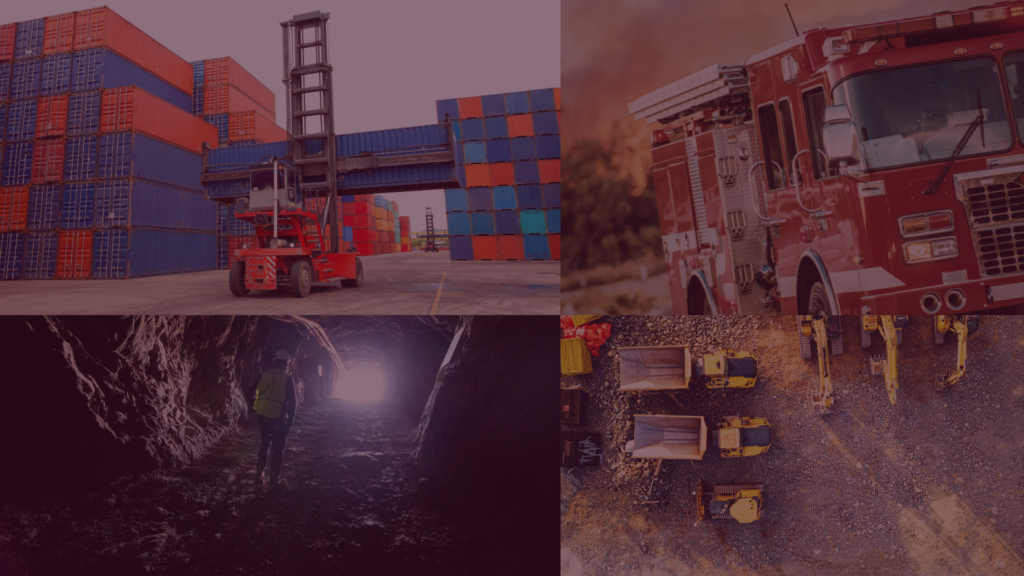
Across five distinct applications including underground mining, construction, ports and material handling, terminal tractors, and fire and emergency response - the electric value proposition looks different in each one. But there’s a consistent pattern: electrification tends to be most powerful precisely where diesel systems are working hardest against their own design limits.
Terminal tractors are a clear example. Their duty cycle, low-speed, high-torque, constant stop-and-go, with 30 to 50 percent idle time is nearly the worst possible operating profile for a diesel aftertreatment system. Diesel particulate filters require elevated exhaust temperatures to regenerate, and terminal tractors rarely reach them. The result is frequent forced regeneration events and accelerated filter maintenance, one of the most consistent sources of unplanned downtime across yard fleets. Electric drivetrains eliminate the problem at the source.
In construction, the advantages distribute differently: noise reductions of 10 to 15 decibels (perceived as roughly half as loud) can unlock off-hour work permits on time-sensitive urban projects. Reduced idle-hour accumulation on the powertrain extends service intervals. And energy cost reductions of 60 to 75 percent per operating hour improve total cost of ownership across the machine’s working life.
In port and material handling, operators see two-to-three times the energy efficiency of diesel, compounded across 16 to 20 operating hours per day and that delivers fleet-level savings that show up on the P&L. Add regenerative energy recovery during lift-and-lower cycles, and maintenance cost reductions of 50 to 75 percent versus Tier 4 diesel, and the TCO case becomes difficult to argue against for high-utilization operations.
Fire and emergency response may be the least obvious application, but the occupational health data is hard to ignore. Cancer now accounts for approximately 72 percent of firefighter line-of-duty deaths, with diesel exhaust exposure inside station apparatus bays identified as a major contributing factor. Electric fire apparatus removes the tailpipe emissions at the source, not through mitigation, but elimination.
Battery Selection Is a Core Engineering Decision
Across all five applications, one principle holds: battery selection isn’t a procurement decision made late in the design cycle. It’s a foundational engineering decision that determines performance, reliability, and serviceability across the working life of the platform.
Right-sizing the pack to actual duty cycle, designing for the thermal environment the machine will operate in, aligning charging architecture with available infrastructure, and building for field serviceability - these aren’t afterthoughts. They’re the variables that determine whether the machine performs well across its entire service life.
OEMs who get this right are those who bring their battery supplier into the conversation early, at the concept and architecture stage, not just the production stage.
Want to go deeper into any of these applications?
Our recent webinar, Powered to Perform: Real-World Benefits of Going Electric, covers all five applications in detail including the engineering data behind these numbers, real-world fleet deployments, and a practical framework for battery selection by application type.
Stay up to speed as we power the future of electrification
Get company updates, new product announcements, and essential industry news delivered straight to your inbox.