
FAQs on Port Equipment

This FAQ answers the basic questions about electrifying industrial port equipment including the vocabulary and concepts that apply industry-wide, not just to Proterra specifically.
-
What Port Equipment Can Be Electrified Today?
Most mobile cargo handling equipment at ports can run on batteries today. Commercially available battery-electric options include yard (terminal) tractors, top handlers, empty container handlers, reach stackers, heavy-lift forklifts, and straddle carriers.
Port electrification has moved past the pilot stage for many machine types. The equipment best suited for batteries shares a few traits: predictable duty cycles, time spent inside a defined terminal footprint, and natural breaks in the shift where a machine can charge.
Yard and terminal tractors: the most widely deployed electric port machine, thanks to low speeds, heavy stop-and-go use, and regenerative braking.
Top handlers and empty container handlers: large battery systems now support full-shift operation. Taylor Machine Works’ battery-electric ZLC series, powered by Proterra, can stack loaded 40-foot containers up to six high.
Reach stackers and heavy-lift forklifts: major OEMs now offer battery-electric models, with Taylor’s ZH series forklifts rated from 36,000 to 100,000 lbs.
Straddle carriers and rubber-tired gantry cranes: available in battery-electric and hybrid versions from several manufacturers. -
Which port equipment is easiest to electrify first?
Yard tractors are usually the easiest starting point. They run at low speeds, idle often, and stop and start constantly, which is where electric drivetrains beat diesel on efficiency. Their battery packs are also smaller than those of top handlers, which keeps upfront cost and charging needs lower for a first deployment.
-
Can battery-electric equipment handle full-weight containers?
Yes. Battery-electric top handlers are rated for loaded containers. Taylor’s ZLC-996, powered by a 984 kWh Proterra battery system, handles loads up to 90,000 pounds and stacks 40-foot containers up to six high. Electric motors also deliver full torque from a standstill, which suits heavy lifting.
-
Is ship-to-shore crane electrification the same as mobile equipment electrification?
No. Ship-to-shore cranes are typically already powered by the grid through cables. Mobile equipment electrification means replacing diesel engines in machines that move freely around the terminal, like yard tractors and top handlers, with onboard battery systems that recharge between or during shifts.
-
What is total cost of ownership for port equipment?
Total cost of ownership (TCO) is the full lifetime cost of a machine: purchase price, energy or fuel, maintenance, downtime, charging or fueling infrastructure, and resale or end-of-life value, minus any incentives. For electric port equipment, TCO gives a truer comparison with diesel than sticker price alone.
-
How long does it take for electric port equipment to pay for itself?
Payback depends mostly on hours of use, local electricity rates, and diesel prices. Published analyses of electric yard tractors show payback in roughly three to four years for moderate-use sites and up to about six years in other operations. High-utilization, multi-shift terminals typically see the fastest return.
-
How Long Does Electric Port Equipment Run Per Charge?
Many battery-electric port machines now run a full shift or longer on one charge. Taylor’s battery-electric top handlers, powered by Proterra battery systems, run 16 to 20 hours on a single charge, and the product line supports full two-shift operation. Actual runtime depends on battery size, load, duty cycle, and weather.
Runtime is a function of how much energy the battery stores and how hard the machine works. A top handler lifting loaded containers all day draws far more energy per hour than a yard tractor shuttling chassis.
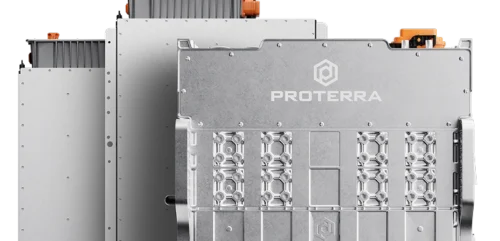
Battery size: Proterra’s Onyx battery platform scales from individual packs of 40 kWh to possible 1MWh systems.
Duty cycle: idle time, lift frequency, travel distance, and load weight all affect energy use.
Regenerative braking: electric drivetrains recapture energy when slowing down, which helps in stop-and-go terminal work.
Opportunity charging: short top-ups during breaks or shift changes can extend operation well beyond a single charge.
The right battery size comes from matching real duty-cycle data to the operation, not from picking the largest pack available. -
How big are the batteries in electric port equipment?
Battery size varies by machine. Electric yard tractors use comparatively small packs, while large container handlers need much more energy.
-
Does hot or cold weather affect electric port equipment runtime?
Temperature can affect battery performance. Extreme heat or cold can reduce available energy and charging speed. Liquid-cooled battery systems, like those on Proterra’s Onyx platform, actively manage cell temperature to protect performance and battery life in demanding outdoor environments such as port terminals.
-
Can electric port equipment work multiple shifts?
Yes. Multi-shift operation is possible through a larger battery, opportunity charging during breaks, or both. The best approach depends on the terminal’s schedule, charger locations, and available grid power alongside the design of the electric equipment.
-
How Do You Charge Electric Port Equipment?
Electric port equipment is charged in one of four main ways: depot charging during scheduled downtime, fast opportunity charging during short breaks, rotating machines in and out of service, or battery swapping. Most terminals combine methods, matching the charging approach to shift patterns, equipment type, and the grid power available on site.
Charging strategy shapes everything from how many chargers a terminal needs to how much grid capacity it must secure.
Industry planners generally group options into four approaches:
Depot charging: machines charge during fixed breaks or overnight. Simple to manage, but machines need enough battery for their full work period.
Fast opportunity charging: short, high-power top-ups during breaks or idle windows. Allows smaller batteries but requires higher-power chargers placed near work areas.
Vehicle rotation: extra machines let some charge while others work. Useful for fleets of yard tractors.
Battery swapping: depleted batteries are exchanged for charged ones. Less common, and it requires handling equipment and spare packs.Emerging options include automated conductive connectors and inductive (wireless) charging, which can reduce the time operators spend plugging in.
The right mix lowers peak power demand. Staggering charging across the fleet, rather than plugging everything in at once, can reduce the size of the grid connection a terminal needs.
-
How long does it take to charge electric port equipment?
Charge time depends on battery size and charger power. Smaller machines on high-power chargers can top up meaningfully in under an hour, while very large container handler batteries typically charge over several hours.
-
Where should chargers be located at a port terminal?
Chargers work best close to where equipment naturally pauses: near break areas, staging lanes, or maintenance zones. Good siting cuts non-productive travel to and from chargers. Terminals also need to plan cable routing, protection from vehicle impact, drainage, and space for future chargers as the fleet grows.
-
Can ports use the same chargers for trucks and cargo handling equipment?
Sometimes. Many yard tractors and drayage trucks use the same CCS charging standard, so shared chargers are possible. Larger cargo handling equipment often uses OEM-specific or higher-power connections. Standardizing connectors where possible gives terminals more flexibility and reduces the total number of chargers needed.
-
Are batteries a safe option for port-equipment?
Yes, when the battery is engineered for heavy-duty commercial use. Port-grade battery systems combine active safety features, such as liquid cooling and intelligent battery management, with passive protections, such as rugged enclosures and cell-level fault tolerance. They are validated through vibration, impact, crush, ingress, and abuse testing before deployment.
Ports are tough on equipment. Salt air, heat, rain, constant vibration, and heavy impacts all test a battery’s design. Commercial battery systems, such as Proterra's Onyx Platform, address these risks in layers.
Active safety: liquid cooling keeps cells within a safe temperature range, while the battery management system (BMS), the onboard computer that monitors every cell, detects faults and limits charging or discharging when needed.
Passive safety: Proterra battery packs use ballistic-grade enclosures and single-cell fault tolerance, meaning the pack is designed so a fault in one cell does not spread to its neighbors.
Environmental protection: ingress protection testing verifies that packs keep out water and dust.
Validation: Proterra tests packs in-house for vibration, impact, crush, cycle life, abuse, and mechanical reliability.Ports should also plan site-level safety: emergency response procedures, first-responder training, and charging area design, in coordination with local fire authorities.
-
How do port batteries hold up to salt air, rain, and vibration?
Commercial battery packs for off-highway equipment are sealed and tested for these conditions. Ingress protection testing confirms resistance to water and dust, and vibration and mechanical reliability testing simulates years of rough terminal operation. Proterra packs use rugged enclosures designed for demanding on- and off-road commercial environments.
-
What safety training do port operators need for electric equipment?
Operators need training on charging procedures, reading battery status and alerts, and what to do if a fault occurs. Maintenance teams need high-voltage safety training before servicing electric equipment. Ports should also brief local fire departments on battery-electric equipment and site layout as part of emergency planning.
-
What affects battery lifespan in port equipment?
The biggest factors are temperature, depth of discharge, charging rate, and total hours of use. Batteries last longest when cells stay within a moderate temperature range and are not routinely driven from full to empty. Liquid cooling and a well-matched battery size help protect long-term capacity in demanding port duty cycles.
-
What Funding Is Available to Electrify Port Equipment?
The largest U.S. source has been the EPA Clean Ports Program, which awarded nearly $3 billion in 2024 for zero-emission port equipment and infrastructure. Those grants are now in implementation, and no new round has been announced. Ports should also check state air-quality programs, utility incentives, and port authority funding.
Funding for port electrification has come from federal, state, and local sources, and the landscape continues to shift.
EPA Clean Ports Program: funded by the Inflation Reduction Act, the program selected 55 projects across 27 states and territories in October 2024. Selected projects included more than 1,500 units of cargo handling equipment, along with drayage trucks, vessels, shore power, and charging infrastructure.
Implementation timelines: EPA reports that funded projects have three to four years from award to complete, depending on scope. As of August 2026, the application period is closed.
State and regional programs: state air-quality agencies and regional air districts, especially in California, have historically funded zero-emission cargo handling equipment.
Utility programs: some utilities offer make-ready infrastructure support or special electric rates for fleet charging.
Federal incentives have become less predictable, so the strongest projects are built on business cases that work with or without subsidies. -
What is the EPA Clean Ports Program?
The EPA Clean Ports Program is a federal grant program funded by the Inflation Reduction Act to help ports buy zero-emission equipment and infrastructure. In 2024, EPA awarded nearly $3 billion to projects nationwide, including more than 1,500 units of cargo handling equipment. The application period is closed and projects are in implementation.
-
What does Buy America and BABA compliance mean for port equipment batteries?
Build America, Buy America (BABA) and Buy America rules require federally funded projects to use equipment and materials that meet U.S. manufacturing requirements. For ports using federal grants, battery sourcing can affect eligibility. Proterra batteries are designed in California, manufactured in South Carolina, and are Buy America and BABA compliant.
Domestic content rules have become a bigger factor in port equipment purchasing, especially for projects that use federal funds.
What BABA covers: the Build America, Buy America Act, part of the 2021 Infrastructure Investment and Jobs Act, sets domestic content requirements for federally funded infrastructure.
Waivers are narrowing: EPA issued a BABA waiver for parts of the Clean Ports Program in 2024, and waivers like it are expiring or under review.
Supply chain stability: batteries made in the U.S. reduce exposure to shipping delays and shifting trade policy.
Proterra’s footprint: Proterra designs batteries in California and manufactures them at its battery production facility in Greer, South Carolina, supporting Buy America, BABA, and USMCA compliance. -
What is the difference between Buy America and BABA?
Buy America refers to long-standing domestic content rules tied to specific federal programs, such as transit funding. Build America, Buy America (BABA), enacted in 2021, extended domestic content requirements across a much broader range of federally funded infrastructure. Which rule applies depends on the funding source for a given project.
-
Why does domestic battery manufacturing matter for ports?
Domestic manufacturing helps ports meet federal funding requirements, shortens supply chains, and makes service and parts support easier to access. It also reduces exposure to international shipping disruptions and changing tariffs, which matters for long-term fleet planning and equipment availability.
See Proterra's press release announcing a US Cell supply option: https://proterra.com/news-and-press/proterra-announces-u-s-cell-supply-option-for-onyx-battery-platform/
-
What should equipment manufacturers look for in a battery partner for port machines?
Equipment manufacturers should look for a battery partner with proven heavy-duty deployments, a modular platform that scales to different machines, rugged safety design and testing, domestic manufacturing for Buy America and BABA projects, and engineering support for integration. Aftermarket service and parts support matter just as much once machines are in the field.
For an OEM, the battery is one of the most important supply decisions for an electric machine. The right partner shortens development time and reduces field risk.
Proven performance: look for real-world deployments in demanding duty cycles. Proterra batteries power port, construction, mining, transit, school bus, and Class 8 truck applications.
Scalable, modular packs: Proterra’s Onyx platform offers Onyx Slate for larger vehicles and Onyx Strata for tight spaces, with packs from 40 kWh to over 200 kWh.
Safety and validation: in-house vibration, impact, crush, ingress, and abuse testing.
Integration support: Proterra’s Rapid Development Starter Pack is a high-voltage integration tool that helps OEMs move from prototype to production faster.
Lifecycle support: battery parts, service, and technician training through Proterra’s aftermarket team.
Stay up to speed as we power the future of electrification
Get company updates, new product announcements, and essential industry news delivered straight to your inbox.