
Navigating Buy America, BABA, and USMCA: What Every Commercial EV Buyer Needs to Know

Summary:
Buy America, BABA, and USMCA each set different domestic content rules for EV funding and tariffs. Learn the key differences and how battery sourcing affects compliance.
Federal funding has become one of the biggest accelerants of the shift to zero-emission transportation, and one of its biggest sources of confusion. Transit agencies, fleet managers, and OEMs have seen billions in infrastructure and vehicle funding made available over the last 5 years. However, accessing that funding, or benefitting from tariff-free treatment in your supply chain, means navigating a maze of domestic content rules that are at times hard to parse: Buy America, Build America, Buy America (BABA), and the US-Mexico-Canada Agreement (USMCA), just to name a few. Each has a different threshold, a different scope, and a different consequence for getting it wrong.
For anyone building or buying electric buses, trucks, or off-road equipment, understanding these three frameworks isn't a compliance afterthought. It's a competitive advantage. Here's what they actually mean, how they differ, and why your battery supplier's manufacturing footprint might be the single most important factor in your electrification strategy.
Understanding the Difference Between Buy America and BABA
Buy America and Build America, Buy America (BABA) are both content requirements tied to federal funding, and that shared lineage is exactly why they get confused. But they apply to different money and different thresholds.
Buy America is specific to the transportation industry – affecting rail and transit funding authorized by the federal government. For the commercial EV sector, this is mostly via the Federal Transit Administration (FTA). Any transit OEM receiving federal transit funding must source at least 70% of its component costs domestically, and the final vehicle, the "rolling stock," must be manufactured in the US. It's a well-established standard, and it's the one shaping how the FTA administers formula funding and how transit agencies manage and award their own federally-funded RFPs today, particularly as funding tied to the next highway bill, the Build America 250 Act, works its way through Congress.
BABA, introduced in the 2021 Bipartisan Infrastructure Law, was designed to solve a different problem: a patchwork of federal agencies with no consistent domestic content standard. BABA created a floor of 55% US content and a domestic final-assembly requirement for any federal program that didn't already have its own rule. The catch is that BABA's implementation isn't uniform. While each agency, such as the EPA, the DOE, and others, must follow the letter of the BABA standard as written in statute, agencies are allowed to interpret and apply it differently, sometimes extending requirements down into sub-components. That layer of unique application makes a supplier's overall US manufacturing depth more valuable, not less, because it provides a hedge against however a given agency chooses to enforce the rule.
Where the Battery Fits in the Bigger Compliance Picture
One nuance that gets lost in the compliance conversation: these percentages apply to the entire vehicle or piece of equipment, not just the battery. An OEM sourcing a fully Buy America- or BABA-compliant battery from a supplier like Proterra gains real flexibility elsewhere in the bill of materials, since the battery represents a substantial share of a vehicle's total cost. That flexibility can be the difference between a program that pencils out and one that doesn't.
It's also worth remembering that compliance is only half the equation. Fleet managers and OEMs still need the best-performing battery on the market. Compliance without performance doesn't win contracts. The two goals must move together, which is why supplier selection matters as much as the regulatory checklist itself.
USMCA - A Different Game Entirely
Buy America and BABA are about accessing funding. USMCA is about avoiding cost. As a free trade agreement rather than a content requirement tied to federal dollars, USMCA offers tariff-free treatment across North America to products that meet its rules-of-origin standards, but the bar is materially higher. Where Buy America and BABA typically require compliance down to Tier 2 or Tier 3 suppliers, USMCA requires showing that raw materials themselves carry US, Canadian, or North American origin.
That distinction matters right now because USMCA is in flux. The United States recently declined to extend the agreement for another ten years. This is not an end to USMCA, but a signal that renegotiation of key provisions, including rules of origin for auto parts, is actively underway. For any OEM with a manufacturing footprint that touches Mexico or Canada, or with meaningful end markets there, the direction of that renegotiation is worth watching closely.
The Real Takeaway: Know Your Supplier's Footprint
Across all three frameworks, the common thread is the same. Regulatory requirements will keep shifting, thresholds may rise, agency interpretations may diverge, trade agreements may be renegotiated, and the companies best positioned to adapt are the ones that already know exactly where their components, sub-components, and raw materials come from.
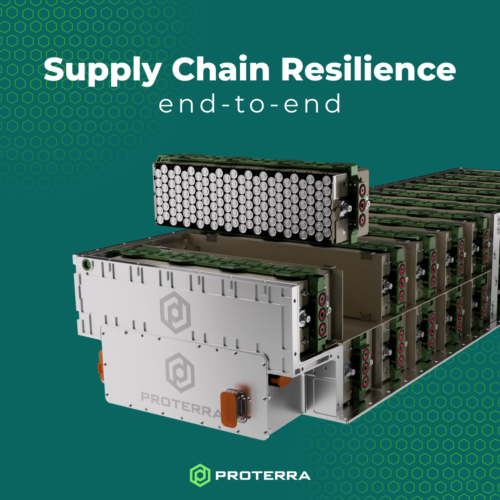
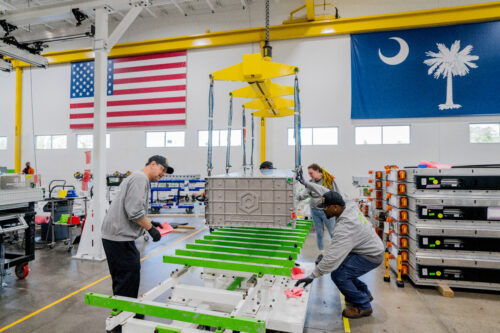
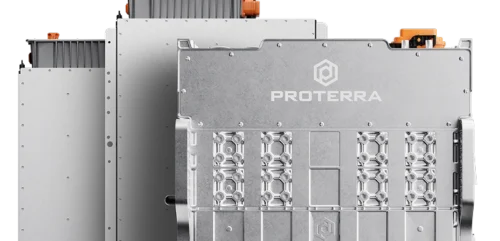
That's the philosophy behind Proterra's own approach. Our batteries are manufactured in South Carolina, and we've built toward 100% US content classification for Buy America purposes by bringing not just cell procurement, but enclosure, ancillary bay, and additional components onshore. Where full onshoring isn't yet possible, we're near-shoring to strengthen North American content and position our customers well ahead of USMCA's evolving standards. The goal isn't just passing today's compliance check, it's giving OEMs and fleet operators confidence that their supply chain can absorb whatever comes next.
In a policy environment moving this fast, that kind of visibility isn't a nice-to-have. It's the foundation of a resilient electrification strategy.
Want to talk through how domestic content requirements affect your next procurement or manufacturing decision? Visit proterra.com - we're happy to help you navigate it.
Watch our latest episode of High-Powered Insights to hear David Rubin, Proterra’s Head of Policy, explain and walk through the details.
Stay up to speed as we power the future of electrification
Get company updates, new product announcements, and essential industry news delivered straight to your inbox.